I’ve Been Living in Pain for 25 Years – Here Are 7 Things That Actually Help
Sometimes, all it takes is a number of little tweaks to your lifestyle to feel a marked improvement in your daily quality of life
If you buy through our links, we may earn a small fee at no extra cost to you

Not every accessory or habit works for everyone in chronic pain, but finding the things that improve your quality of life can make all the difference day-to-day. Photo: Unsplash
This article is based on personal experience and general pain science education. It is not medical advice and is not a substitute for care from your doctor.
Whether you’ve been Living In Pain for as long as you can remember, or this is a more recent chapter, some things really do help pain beyond medications and hospital treatments. When you’re in chronic discomfort, even a 20% improvement in your quality of life can bring significant psychological and physical relief.
As someone who has lived with intense chronic pain for 25 years due to severe endometriosis and Ehlers-Danlos Syndrome, among other health conditions, I have learned through trial and error what actually helps. In addition, I have worked as a senior journalist in the UK national press since 2008, so I approach health information with care and critical thinking.
This article draws on my lived experience, widely accepted pain science, and conversations I have had with health professionals over the years, both as a patient and as a journalist.
It goes without saying you can pick and choose any of these, stop and start them as it suits you, but always consult your doctor first.
1. Adaptive Pacing Your Activities, Tasks and Responsibilities
There is no denying the emotional and physical toll pain can take. Your world may have grown increasingly small, you may have let go of dreams and goals, and sometimes it can feel like you are barely surviving.
While the cause of your chronic pain may not be something you can easily resolve or be rid of, learning to function around it is essential for your well-being, and has been shown in studies to be a practical way to improve your quality of life and better manage your symptoms. which is why adaptive pacing is a must. This involves finding your baseline for daily function without a flare, injury or fatigue, spreading out your high-energy events or tasks across days, weeks or months, and building in time for recovery. You can gradually increase it over time to improve your overall capacity to do the things you would like without paying the physical price for it.
To grasp this somewhat abstract concept, imagine every chunk of your pain tolerance, energy, physical and emotional capacity for movement and endurance for your responsibilities or social life has a unit value. Let’s call each a ‘spoon’, after the famed Spoon Theory, by American writer Christine Miserandino, who coined the term in 2003.
Every day, you will wake up with a limited amount of spoons. Each activity takes up some of those, and once your finite number of daily spoons is gone, they’re gone for the day. You’re now in a spoon deficit. You will also have fewer spoons to start with if you’re in a flare, recovering from acute illness, injury, surgery or otherwise.
For me, for example, showering, styling my hair, cooking, driving, having meetings, socialising, going out for a meal, or even hanging the laundry out to dry are high-spoon activities. I can’t do them as often as I like. Going to the office means I use a week’s worth of spoons in one day, which leads to fatigue and pain, as well as brain fog for days after.
How much I can do in any one day without a pain flare or energy crash is what is known in adaptive pacing as your baseline.
As you’ll see below from my Visible app, which I use with a Visible band to track my Heart Rate Variability and fatigue, I’ve learned my max pacing points (much like spoons) to be 15 units. I have seen that if I go over that, I am at risk of a physical pain flare or energy crash. For context, the app set my daily pacing points at nearly 30 initially, which I had to titrate down immediately.
This week was a rough one, and I pushed beyond my capacity, bringing a detrimental effect for days after.
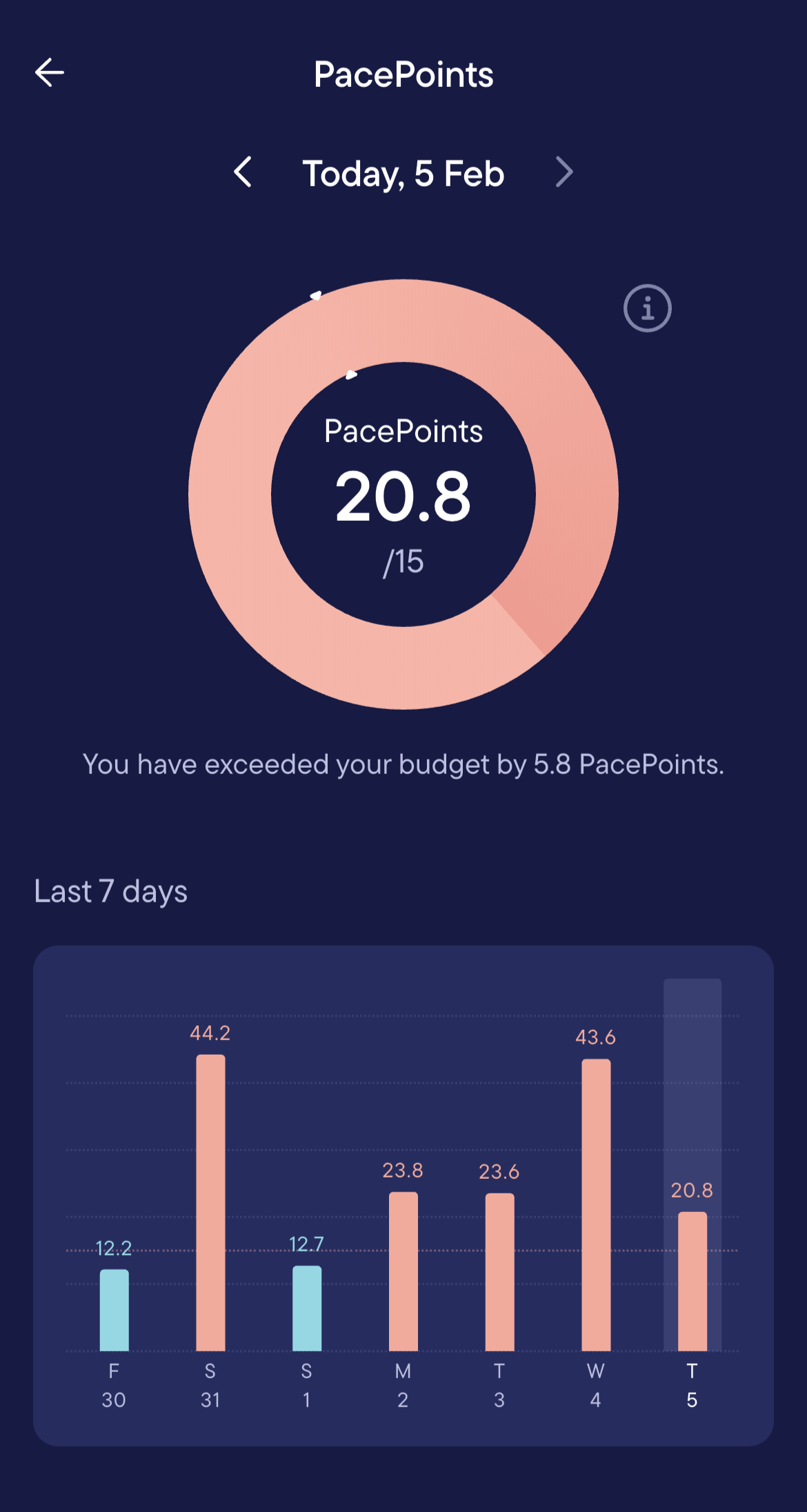
This screenshot shows my pacing budget over a recent week, from my Visible app. You can see all the days I’ve gone over my max pace points. By the time I reached Thursday, I was really exhausted and fast moving towards an energy crash. Photo: Living In Pain
Figuring out what your baseline looks like takes vigilant tracking and honesty with yourself, and the ability to hit the pause button. A week or two of observation should do it. Once you have your baseline and a better grasp of which activities are extremely spoon-zapping, you can plan and space out tasks without flares or crashes.
This is what adaptive pacing is. It helps me run a more functional life with a calendar that has rest and recovery hours and days built in - big or small - around my plans and needs. I know I need an extra day of annual leave, for example, from work before and after a holiday or weekend trip in order to stay in bed, move more slowly, regain my strength or recover from EDS injuries. Sometimes, it’s time allocated to staying in bed all day because that is what my body needs.
Adaptive pacing is reactive, too. After nights of terrible, little or interrupted sleep, or high-intensity days, I shift high-energy items off my to-do list or ask for help.
This helps me manage and feel better daily without much more than a calendar and notepad in hand (I do most of mine on my iPhone, apart from my pretty to-do list pad from Amazon that lives on my work desk and acts as a brain dump to avoid the energy zap that holding lots of to-do lists in your head can bring.
Adaptive pacing is also the way you can sensibly start to increase how much you can do without injury or flares, over a longer time frame. This is how I built myself back up to full-time work, gradually increasing them tolerance and spoons.
Other Things I Had Tried
Previously, I had tried tracking my daily steps using my Apple Watch, and learned that the data was a useful indicator for how many steps meant I was at high risk of an SI Joint dislocation and needed to stop.
Then I kept hearing about the Visible Band, which tracks your heart rate variability and other symptoms to let you know how many of your units of energy you have left. I have been wearing mine 24/7 for more than a year, and I can honestly say that when it says it’s built for people with chronic illness or fatigue, they are not kidding.
It’s beautifully useful, intuitive, providing live updates and alerts telling you to rest when you need, or if you wake up less physically stable and need to take your foot off the gas, so to speak. I particularly love that the battery is long-lasting, going for around two to three weeks without needing a recharge, and that it produces monthly and quarterly reports, showing how your symptoms are trending over time.
I have used my data, which you can very easily download or save as a PDF, to talk to my doctor about my pain and the escalation in my symptoms, as well as my employer about the need for some reasonable adjustments.
This kind of objective data can be incredibly helpful when trying to understand patterns in your symptoms and when communicating it to others.
It comes in an arm band and, more recently, a new wrist band version, and has an upfront and a monthly cost.
2. Nervous System Regulation to Reduce Pain Amplification
The mind-body complex is a beast. I have seen this for myself when stressful weeks or acutely upsetting events have turned up the dial on my physical pain. This isn’t me saying the pain is in your head. It’s just a physiological fact that pain and stress travel on the same nervous system pathways, so if you turn up the dial on one, the other will usually amplify with it. Stress also means your built-in tolerance for fatigue and pain reduces, making everything feel worse.
That’s why nervous system regulation has been the holy grail I’ve been working on nailing for the last decade. I realised how much my stress and long-term trauma were having an impact on my pain when I was having IVF in 2014-15. I had therapy and found that as a result, both dialled back somewhat.
Using somatic release, journaling, seeking support in my close friends and husband, leaning into daily ‘glimmers’ for mindset work, box breathing and vega nerve activation to physically kick my parasympathetic nervous system into ‘restoring equilibrium’ mode has brought enormous benefit to me whilst I continue to live in pain.
Alongside therapy, I transformed my ability to self-regulate so I don’t spiral into anger or tiring and energy-zapping extreme emotions daily, as well as improving my sleep and emotional well-being. Being able to let things go is a skill I’m still working on, but much improved from where I was five years ago.
These changes have built resilience, better tolerance, and the bonus of helping reduce my pain ‘noise’.
I have found the Curable app, which I have been using on and off since the misery of repeated lockdowns in 2020, very helpful at certain points when I needed a wider-reaching nervous system reset. It focuses on up-to-date pain science education and mental exercises that aim to reduce the protective mechanism of pain amplification in the body. I return to it when I feel my stress and pain levels creeping up again. It’s not an instant fix, though, so be prepared to chip away at the tasks and recordings you will need to listen to.
It’s not a membership that I keep perpetually, but for a few months at a time for a deeper reset. It’s up-to-date pain science, and the audio workshops you can work through at your own pace are incredibly useful.
Knowledge is power, and Curable delivers it to your eyes and ears from the comfort of your smart device, and all you have to do is read and listen.
3. Physiological Trackers to Help You Learn Your Limits and Triggers
As mentioned earlier, I rely on multiple trackers to help me get objective data about what my body is going through so that I can adjust activities and support it, and spot insidious patterns that I may otherwise no thave.
Here are a few trackers you can consider:
Get a Smart Watch
Count steps, track your breathing, heart rate, sleep quality and more. I’ve tried six different ones, including affordable smart watches from Amazon, higher-end aesthetically pleasing ones, and my favourite, reliable and easy to use recommendation is the Apple Watch Ultra 2.
Much like the rest of my Apple ecosystem, it does exactly what it is supposed to, is an asset to me daily and connects with my other technology, such as my Visible band, without a hitch.
It’s a higher initial up-front cost, yes, but I’ve learned the hard way that cheap smart watches break, behave weirdly, stop functioning and are often a waste of money.
In my experience, investing in a reliable device has saved me money long term compared with repeatedly replacing cheaper ones.
I have the Apple Watch SE, available from Apple, and it’s been running like clockwork, pun intended, for four glorious years. It wasn’t the latest model, even when I bought it, and that was fine, as the software is always the latest the moment you update it, and I valued my budget more than the latest release.
Track Your Symptoms Digitally
I use Visible to track symptoms and crashes, as detailed earlier. It carries an upfront (around £75) and monthly cost (around £15) that, for me, is worth its weight in gold.
Alternatively, you can try Welltory for HRV, apps like Bearable for mood, meds and symptoms, or Garmin Connect’s Body Battery for HRV and sleep data. MySymptoms and FlareDown are great for a range of tracking features for those chronically in pain or dealing with illness.
A heads up that they vary in cost and may include in-app purchases.
Keep a Log
Keeping a digital or analogue note of your daily symptoms will help doctors take your pain seriously and understand the impact of your pain and other symptoms better than a subjective narrative (your story) alone. It’s not right that this should be the case, but often it is.
I like the A5 daily diary from Amazon that has lines for each hour and a note section. It’s light enough to carry with you without strain, but it also has enough space to make your notes useful. We also have a free-to-download and print-at-home pain log template for your use.
4. Use AI to Cut Mental Load and Ease Brain Fog
Oh, brain fog, you old dog. What a terrible nuisance it is when it feels like you are moving through mental treacle. That’s where I make use of AI, and after trying three free ones, including ChatGPT, Gemini is the one I use daily as it doesn’t lock in upload limits.
Here are some of the brilliant ways you can use AI to do the heavy mental lifting for you and save yourself some vital spoons:
Planning shopping lists for the weekly food shop, and recipes to match. You can even take a picture of what’s in your fridge, freezer or pantry and ask AI to build you a simple plan with recipes that need minimal prep and standing time, using what you already have in the house. I also use it to simplify cooking complex foods to make prepping easier and ask how I can adapt my favorite meals to cut prep and cooking time. It’s brilliantly inventive.
Timetabling a trip, meal, or other logistics you feel too mentally fried to complete.
Doing some legwork on your research into resources or help for a condition. AI doesn’t replace medical advice, cannot diagnose you and can and will get things wrong. Take its answers with a pinch of salt. However, it’s a good starting point when you’re doing research or trying to better understand what might be happening in your body.
Medical advocacy. I use mine all the time for an initial draft of a script or useful prompts to take to the doctor or consultant so that in the stress of the moment, I don’t forget what I need or want to say.
Remember: AI can make mistakes. You are ultimately responsible for how you use AI.
5. Medication Without Self-Stigmatisation
When disease processes are going on in your body, taking the medication your doctors and consultants have prescribed you can help you manage some of the trickier symptoms.
Sometimes that might be a painkiller, a drug that reduces nerve pain, inflammation, or helps you sleep better. It might be something that regulates your mood or stops your periods. There are so many avenues to explore, and finding the right combination for you, if medication is on your radar to help when Living In Pain, is crucial.
I have given a lot of medications a go. Some have worked really well, others have had no impact or started a cascade of unbearable side effects. I now have a regimen that involves quite a lot of pills, gels, and topical prescription medications. Honestly, it’s the only way I can keep working. Otherwise, I’d have to give up and stay in bed all day.
So let go of any internal prejudice, stigma or judgment you are carrying for whatever reason and speak to your doctor for help on improving some of your most bothersome symptoms and therefore, your quality of life.
Any medication decisions should always be discussed with your healthcare team.
6. A Supportive Partner or Loved Ones
It’s OK to say goodbye to people who break your boundaries, do not accept that your pain is real, or simply bring you stress and make you unhappy. It’s your call whether you tell them or not that you’re reducing contact. And it doesn’t have to be a no-contact situation.
You can reduce contact, reply to communications when it suits you, take a break or grey-rock people. Grey rocking is a psychological tactic that means to literally be as boring as a rock. Give them nothing, and protect your peace. You don’t owe anything for your personal information.
When you are Living In Pain, you must take care of yourself and keep your nervous system as steady as possible. Any intrusion into that can negatively impact your pain levels and other symptoms, and that is a price nobody should have to pay.
This also means having and keeping firm boundaries. This can be hard for many, and honestly, for years, that included me. I put everyone’s needs before my own as a people-pleaser who found it hard to say ‘no’, and it was truly exhausting.
Now, I am in tune with when I need to stop, have to rest, simply don’t want to do that social thing in my calendar, or need to take some time to just stop and regroup. If that makes other people uncomfortable, then that’s a shame, but my boundaries and what I need to do to protect my health are no longer a negotiation.
So:
Cancel plans if you don’t want to, or can’t go
Don’t wear makeup or style your hair if you don’t want to
Leave a place or social interaction when you need or want to
Take time away from socials and your mobile if you need to
Ask for reasonable adjustments at work
Put a trusted advocate in play when necessary
And remember: ‘no’ is a whole sentence. There is no reason you cannot be polite but firm when looking after your body and mind.
7. Talking Therapy to Support Your Emotional Well-being and Build Resilience
I have been in therapy on and off for 15 years. From CBT to person-centric and EMDR, I have tried many psychological approaches till I found the one that fit me and helped me accept the disabilities I acquired in adulthood, and chronic pain and illnesses that are likely to only get worse over time. I now have boundaries that protect my energy and mental well-being as a result of the self-work I have done.
The best things that have come out of therapy for me:
I stopped being a people pleaser and now ‘hear’ my needs before my body or mind is screaming them at me, or I’ve already had a total collapse.
Having firm boundaries has saved me from fractious relationships that did nothing but stress me out and make me unhappy, no matter what society said about continuing those connections.
Trusting myself. My opinion is enough, and I don’t need external validation to help me navigate life anymore.
Acceptance of my disabled body, and that there is nothing to feel ashamed or guilty about. Everyone has their limits and needs, and each of mine is valid and real.
Accessories I Love and That Really Help
Pain management is not a one-size-fits-all job. What works for me may not work for you. But there are some items I’d love to tell you about as I use them daily, as do many of the spoonies I know in the wonderful online communities I am a part of, and they can help take the edge off an impossible hour or day. I have chosen listings from Amazon for their fast, free delivery and easy returns:
Electric heatpad for immediate muscle tension and relief.
Machine-washable silk eye mask to help me fall asleep in any room.
Loop earplugs to reduce my social overwhelm when coping with high pain and low noise tolerance.
Seven-day pill box so I don’t double-dose or miss doses during brain fog and fatigue.
Gooseneck phone holder to reduce pressure on my wrists and neck.
Living In Pain is hard, but learning about the many factors that impact it (and you) can help pave the path for a better quality of life and more time spent doing what you want with less physical repercussions.
If You Are New to Pain, Start Here:
Begin tracking your energy and symptoms for one to two weeks.
Notice what activities increase flares or crashes.
Build rest into your schedule before you desperately need it, and you’re already in a flare.
Choose one small support tool or strategy to trial at a time so you can really gauge the impact.
Give yourself grace to stop, start, feel sad, mad, or just plain shattered.
Small, consistent adjustments can make a meaningful difference over time, and whilst many of us know the reality of Living In Pain may be that we’re dealing with it to some degree for the long term, incremental and lasting relief can really improve your quality of life.